Du Chinese: Read&Learn Chinese
- 4.8
- Rating
- 500.00K
- Installs
- Free
- Price

 Analysis by App-foxy
I have always found Mandarin reading harder to practise consistently than to study in theory. Textbooks can explain grammar clearly, flashcards can keep characters in memory, and videos can improve listening, but none of those options automatically gives me a comfortable daily reading habit. Du Chinese: Read&Learn Chinese takes a more focused approach: it gives me Mandarin passages that I can read at a level suited to my ability, while keeping explanations close to the text instead of sending me to a separate reference book.
That makes it a useful education app for learners who already know some Mandarin and want to turn passive knowledge into actual reading skill. I would not describe it as a complete replacement for a structured course, especially for someone starting from zero. Its strongest role is different: it acts like a guided reading library, with enough support to help me continue when a word, sentence pattern, or character slows me down.
Developed by Sinamon, the app is free to install and is rated for Everyone 10+. It has built a strong reputation, with an average rating of 4.8 from around 11 thousand ratings and more than half a million installs. The free entry point makes it easy to test the reading method before deciding whether the additional paid material fits my study routine.
You May Also Like

 Blood Strike: 2.5 Anniversary
Blood Strike’s Loadouts Turn Every Drop Into a Tactical Gamble
A close look at Blood Strike’s custom loadouts: how fast access to signature weapons reshapes its battle royale rhythm, rewards preparation, and narrows the gap between fights.

 Pandora - Music & Podcasts
Pandora’s Music Is Easy to Start, but Harder to Recover
Pandora’s strength is its low-effort path from a seed to a station. Its weak spot is how much confidence it asks you to place in connection, setup, and quiet recovery.

 8 Ball Pool
 Is Built on Rivalries, Rematches, and Routine
A close look at the rivalries, rematches, shared routines, and unanswered safety questions that turn a quick pool match into a persistent mobile community.

 Samsung Music
’s Quiet Strength Is Playing What You Already Own
Its reach comes less from spectacle than from dependable access to a personal library. That simplicity is both the app’s strongest retention engine and its ceiling.

 AccuWeather: Weather Radar
AccuWeather Review: A Quick, Clear Forecast for Everyday Decisions
For everyday plans, the best forecast is the one you can understand quickly. AccuWeather makes rain timing, radar, and local conditions easy to act on, with a few trade-offs.

 Hill Climb Racing
Why Hill Climb Racing Still Turns Crashes Into One More Run
A tiny car, a bumpy hill and one more upgrade: Hill Climb Racing keeps resurfacing because its simple chaos makes every near-miss feel personal.
More From Our News Desk



How I use Du Chinese as a repeatable reading habit
I use Du Chinese most effectively when I give each session a small, repeatable shape instead of treating the library as something to browse endlessly. In this section, I’ll focus on how that routine helps me notice progress without turning reading into a checklist, and why returning to a passage can be more useful than rushing into a new one.
A simple session works better than random browsing
My most productive sessions begin with a clear limit: I choose one passage, read it once without stopping too often, and then return to the parts that caused trouble. This is more effective than opening several lessons, checking every unfamiliar word immediately, and ending the session with a long list of disconnected vocabulary. The app is at its best when I treat each text as a small piece of reading practice rather than as a test I must finish perfectly.
On the first pass, I try to follow the meaning from context. I pay attention to who is doing what, where the sentence changes direction, and which words appear to carry the main idea. Only after that do I use the built-in help around difficult words or sentences. This order matters because constant tapping can turn reading into translation. Du Chinese makes support convenient, but convenience can become a distraction if I use it before making any effort to understand the sentence myself.
A realistic everyday routine is a short session during a commute, lunch break, or while waiting for an appointment. I read a passage once with minimal interruption, listen when I want to check the flow, and revisit a few sentences later in the day. The next time I return, I try to read the same material more smoothly before choosing something new. That repeatable cycle gives me more benefit than chasing a large number of lessons.
Why the level system is useful, but not absolute
Choosing material near my ability level is one of the app’s most important decisions. If a passage is too easy, I may read quickly without learning much. If it is too difficult, I spend the whole session looking up vocabulary and lose the rhythm that reading practice is supposed to build. I prefer starting slightly below my maximum, then moving upward when I can understand the general meaning without stopping at every line.
Level labels are helpful starting points, not perfect measurements of my real ability. I may find a passage comfortable because its topic is familiar, then struggle with another at the same level because the vocabulary is less predictable. I therefore judge a lesson by comprehension and effort rather than by the label alone. If I can explain the passage in my own words after reading it, the difficulty is probably productive. If I can only recognize isolated words, I step back.
This is also where the app differs from a conventional flashcard tool. A flashcard app isolates vocabulary and makes review measurable, while Du Chinese shows how words behave inside complete sentences. I still use flashcards when I need deliberate memorization, but I use this app when I want to understand how Mandarin actually moves through a paragraph.
Using audio without turning reading into listening-only study
Audio adds another layer to the experience. I use it after attempting the passage visually, not before. Hearing the text after I have formed my own interpretation helps me notice pauses, sentence boundaries, and words I recognized on the page but could not process quickly enough in real time.
There is a trade-off here. Listening can make a difficult passage feel easier because the spoken rhythm carries me forward, but that does not always mean my reading has improved. For that reason, I sometimes hide or ignore the audio during the first pass, then use it as a check. On another day, I listen first and follow along to practise the connection between sound and characters. Alternating these approaches keeps the feature useful instead of letting it become a shortcut around reading.
My practical vocabulary workflow
When I meet an unfamiliar word, I first ask whether it blocks the sentence. If it does not, I continue and see whether the surrounding lines clarify it. If it does, I check the explanation, reread the complete sentence, and then continue from the beginning of the paragraph. That final rereading is easy to skip, but it is where the new information becomes part of the meaning rather than a detached dictionary entry.
I also avoid saving every unknown word. A word that appears once may not deserve a permanent place in my review system. I pay more attention to vocabulary that repeats, changes the meaning of several sentences, or represents a useful everyday pattern. This keeps study manageable and prevents the app from becoming a collection of tiny interruptions.
Settings that deserve an early check
Before settling into a routine, I recommend exploring how the reading display, audio, and assistance behave. The most helpful setup is not necessarily the one with the most visible support. I prefer a view that lets me concentrate on the Chinese text first, then reveal help when needed. If every explanation is immediately present, I am more likely to read English before attempting the Mandarin.
It is worth testing the interaction with individual words and sentences rather than assuming the default arrangement will suit everyone. A learner who is still building character recognition may want more assistance close at hand, while an intermediate reader may benefit from delaying it. The right balance changes as I improve, so I revisit the setup instead of treating it as permanent.
Audio controls also deserve attention. I use them differently for different goals: a slower, careful listen when checking pronunciation and a more natural pass when training comprehension. I do not keep one speed or method for every session because pronunciation checking and reading fluency are separate tasks.
Another useful habit is to decide in advance what kind of session I am having. A “reading first” session means I resist opening explanations immediately. A “study” session allows more lookups and rereading. A “listening” session puts the spoken version at the centre. This small distinction makes the same library feel more purposeful and prevents me from judging a passage by the wrong standard.
Faster patterns for experienced learners
Once the basic workflow feels comfortable, I find that repeated patterns save more time than frantic tapping. I scan the passage before reading closely, identify its likely topic, and notice whether the opening lines establish a situation or introduce an opinion. That quick preview gives me a framework for new vocabulary. I am no longer meeting each sentence as an isolated puzzle.
I also use a three-pass method. The first pass is for overall meaning. The second focuses on troublesome sentences and useful expressions. The third is a smoother reread, sometimes with audio. This pattern is especially effective when I have limited time because it prevents one difficult sentence from consuming the entire session.
Another strong technique is to revisit yesterday’s passage before opening a new one. I do not reread it to prove that I remember every word. I use it to see whether the text now feels less fragmented. If the same sentence is still slow, I examine its structure rather than simply memorizing its translation. This helps me notice recurring grammar and word order, which isolated vocabulary review often misses.
For learners who like notes, I recommend recording only a few observations after each session: one expression worth reusing, one sentence pattern, and one point that remained unclear. Writing down everything creates a second textbook and makes the habit harder to maintain. The app supplies the reading material; my notes should capture the decisions that matter for future use.
Where it fits beside other Chinese-learning tools
Compared with a textbook, Du Chinese feels less linear but more immediately readable. A textbook is better when I need a planned progression through pronunciation, grammar, and core vocabulary. The app is better when I want to practise those elements in context without spending the whole session preparing the exercise.
Compared with a flashcard app, it offers less control over isolated repetition but gives much richer context. I can see how a word connects to the rest of a sentence, how a phrase sounds, and how meaning develops across a passage. If my main goal is memorizing a fixed list for an exam, flashcards may be more efficient. If my problem is that I know words but cannot follow connected Mandarin, this reading approach is more relevant.
Compared with general news or native-content platforms, it is more approachable for learners because the material is designed around graded reading rather than assuming full fluency. Native content remains essential later, but starting there can make every session feel like decoding. I use Du Chinese as a bridge: structured enough to support me, but closer to real reading than a sentence-by-sentence drill.
Important limits before committing
The app cannot decide what kind of Mandarin learner I want to become. Reading passages can improve comprehension, vocabulary, and familiarity with sentence patterns, but they do not by themselves provide the full speaking feedback of a tutor or conversation exchange. Someone preparing for live conversations should pair this reading practice with speaking and listening activities that require an original response.
It may also be a poor fit for a complete beginner who has not yet learned basic pronunciation and character recognition. The support around the texts can reduce frustration, but it does not remove the need for foundational study. I would begin with a structured beginner course, then add this app when I could read simple sentences and benefit from connected material.
There is a financial consideration as well. The app is free, while in-app purchases range from $11.99 to $119.99 per item. I would not pay simply because the library looks impressive. I would first establish a routine with the accessible material and decide whether I am actually returning often enough to justify expanding it. The value depends heavily on consistent use, not on having the largest possible collection.
Another limitation is that reading support can make me feel more advanced than I am. If I rely on every available explanation, I may understand a passage inside the app but struggle with an unassisted page elsewhere. To avoid that gap, I occasionally read a short section without opening help until I have formed a complete guess. The app works best when it gradually reduces dependence on its assistance.
Who should use it, and who should choose something else
I would recommend it to learners who have basic Mandarin foundations and want a dependable way to read more often. It is particularly useful for people who feel stuck between textbook exercises and authentic content. The graded approach gives enough support to keep moving, while the passages provide more meaningful context than isolated drills.
I would also suggest it to busy learners who need flexible sessions. A passage can fit into a short break, but the same material can support a longer study block through rereading, audio, vocabulary checks, and sentence analysis. That flexibility makes it easier to maintain a habit when my schedule changes.
I would hesitate to recommend it as the only app for someone whose immediate goal is speaking, handwriting, exam preparation, or detailed grammar instruction. Those goals need more targeted practice. I would also steer away from it for anyone who dislikes reading on a phone or tablet; the method depends on spending meaningful time with written Mandarin, and no setting can change that basic requirement.
My verdict after building a routine
Du Chinese: Read&Learn Chinese succeeds because it concentrates on a problem many learners underestimate: moving from recognizing individual words to following connected Mandarin. Its useful features are not just the presence of passages or explanations, but the way I can combine level selection, delayed lookups, audio checks, and repeated reading into a routine that becomes easier to sustain.
The current version is 3.6.1 and supports devices running Android 5.0 or later. Those details matter if I am installing it on an older device, while the free price makes an initial trial straightforward. I would approach the paid material carefully, but I would not judge the app fairly after one quick lesson. Its benefits appear when I return regularly and use the same text in more than one way.
My strongest recommendation is to begin with a modest plan: choose material that is understandable but not effortless, read before looking anything up, use audio as a deliberate check, and revisit passages instead of always chasing new ones. That workflow turns the app from a content browser into a practical reading coach.
For me, the decisive strength is the balance between support and independence. It helps me get through Mandarin without pretending that every difficulty should disappear. If I want a complete language course, I would choose a broader program. If I want to make Chinese reading a regular part of my week, this is one of the more convincing tools I would recommend to a friend.
FAQs for Du Chinese: Read&Learn Chinese
01What is Du Chinese: Read&Learn Chinese, and who is it designed for?
Du Chinese: Read&Learn Chinese is a reading-focused language-learning app for people studying Mandarin. It offers graded stories, dialogues, and articles organized by difficulty, from beginner to advanced levels. The app is especially useful for learners who want to improve reading comprehension, vocabulary, grammar, and listening through practical Chinese content rather than isolated word lists or traditional textbook exercises.
02What learning features are included in Du Chinese?
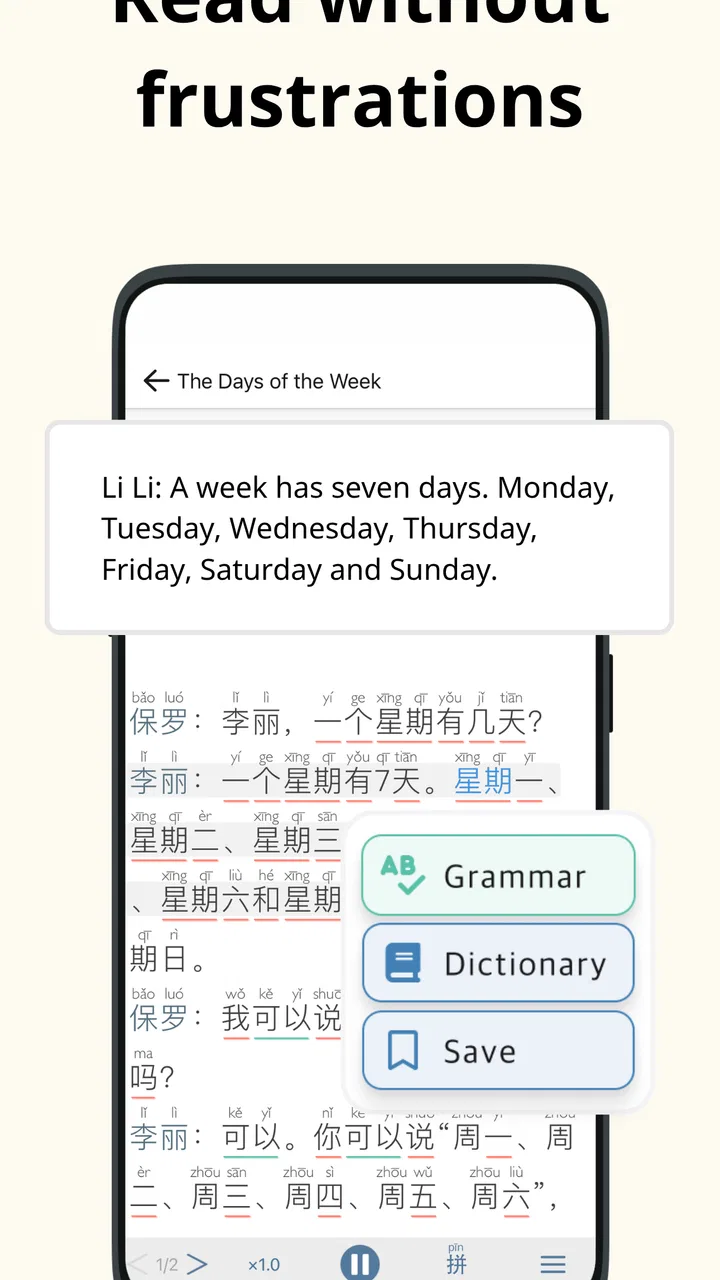
The app combines simplified Chinese texts with pinyin, audio narration, translations, vocabulary explanations, and grammar notes. During reading, you can usually tap unfamiliar words to check their meaning and pronunciation, while audio helps you connect written characters with natural speech. These tools make it easier to study independently and review new expressions in context instead of memorizing disconnected vocabulary.
03Is Du Chinese suitable for complete beginners?
Complete beginners can use Du Chinese, but the experience is generally more comfortable if they already understand basic Mandarin pronunciation and have learned at least some pinyin. Beginner-level material is available and includes helpful translations, audio, and vocabulary support, but users with no previous exposure to Chinese may still need a separate course to learn tones, pronunciation, and fundamental sentence patterns before relying on the app as their main resource.
04Does Du Chinese work offline, and is all content free?
Du Chinese includes free material, but access to the full library and some advanced learning features may require a paid subscription or premium plan. Offline availability can depend on the content and your subscription, so it is best to download lessons before traveling or studying without internet access. Check the current Google Play or App Store listing for the latest pricing, trial terms, and access conditions.
05Can Du Chinese replace a complete Mandarin course?
Du Chinese is an excellent supplement for building reading and listening habits, expanding vocabulary, and seeing grammar used in realistic contexts, but it may not cover every skill equally. Learners who want balanced progress should combine it with speaking practice, pronunciation work, writing or character study, and structured grammar lessons. It works particularly well alongside a class, tutor, flashcard system, or conversation exchange.
Pros
- Short stories make Chinese reading practice feel practical and engaging.
- Adjustable difficulty helps learners find suitable content as they improve.
- Tap-to-translate tools reduce the need to leave the lesson for a dictionary.
- Audio recordings support listening practice and pronunciation awareness.
- Vocabulary review helps reinforce words encountered in reading materials.
Cons
- Some useful lessons and features require a paid subscription.
- The amount of beginner content may feel limited after regular use.
- Reading explanations can be less helpful without prior Chinese basics.
- Audio speed and playback controls may not suit every learner.
- Progress can feel repetitive for users seeking interactive speaking practice.

Du Chinese: Read&Learn Chinese
Gallery